Sharp-tongued actor Glenda Jackson admits to being struck dumb, twice
Glenda Jackson has been talking about what her reaction would be if some hapless soul suggested she try out for a part, and the conversational to and fro which ensues – my disbelief, her certainty – leads to me playing a scene with one of Britain’s most outstanding actors.
“Hello, Ms Jackson, we have a role that would be perfect for you – when might you be available for an audition?”
Jackson: “Thank you for your phone call but you can go f–k yourself.”
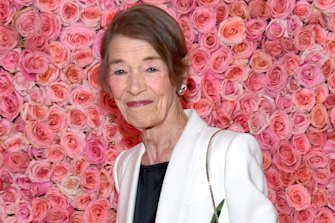
You wouldn’t really, would you? “Of course I would,” she says. “It’s one of the virtues of age that you can play the age card. And I would be saying this from a position where I am the age that I am [83] and I’ve done what I’ve done. When I started out, I would have been grateful to have an audition. So things change.”
For any of us who came of age in the ’70s, Jackson was our pin-up – intelligent, sexy, fierce and thrillingly different. Her looks were intriguing, too, more jolie-laide than conventionally beautiful.

She was a favourite of the director Ken Russell (in one of his last interviews he talked about his four-decade crush on her), who cast Jackson in The Music Lovers, Women in Love and later The Rainbow. She bagged two Oscars (The Music Lovers, A Touch of Class) and was nominated for a third for Sunday Bloody Sunday, also picking up a BAFTA.
The legendary theatre director Peter Brook had spotted her relatively early on – after graduating from the Royal Academy of Dramatic Art (RADA), then rep and four years in the Royal Shakespeare Company – casting her in his 1967 production of Marat/Sade.
Her 1971 Elizabeth R – six 85-minute plays on the BBC – won her two Emmys and was a must-watch series in America and Australia, as well as the UK.
After her two-decade break, during which she devoted herself to politics, Jackson has reclaimed her place on the stage, immediately winning yet more awards – for her King Lear in London in 2016, reprising the role in New York last year (a physical feat, alone, with her on stage for 3.5 hours) and receiving a Tony in 2018 as the matriarch in Edward Albee’s Three Tall Women on Broadway.
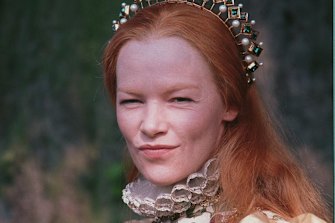
Jackson’s latest work has been the central character, Maud, in a feature-length television adaptation of Emma Healey’s acclaimed 2014 debut novel Elizabeth is Missing.
It’s a highly original detective story told from the perspective of a woman in her 80s who is being sucked into the undertow of dementia while battling to solve the disappearance of her friend (Elizabeth) and a much earlier missing person, her sister, from when she was a child.
The two mysteries melt into one another as Maud’s mind leaks from the present to the past in a perpetual loop. The book manages to be darkly comic – something which Jackson doesn’t have to reach too far to find – poignant and at times alarming.
We had first met four years ago in 2015, when Jackson was appearing in her first part since stepping down from the seat she secured in 1992 as Labour MP, appearing in Emile Zola’s 20-novel cycle Les Rougon-Macquart as a 104-year-old, on radio.
I remind her that she told me then that she wasn’t afraid of death but that she was frightened by the threat of Alzheimer’s or dementia. “I don’t think I said that, did I?” Yes, you did. “Certainly the issue of ill health is frightening.”
In 2004, she had broken her hip and arm and hated being dependent on others; her 50-year-old son, Dan Hodges, a political columnist, wife Michele and their young son, live in the main part of their home in Blackheath, with Glenda downstairs in the garden flat.
As the MP for Hampstead and Highgate (she was also in Tony Blair’s cabinet as junior transport minister from 1997-99 but fell out with him over the Iraq war), she was often made aware of the difficulties families faced when a relative was lost to Alzheimer’s or dementia.
It is an issue which continues to exercise her and is one of the reasons why the script of Elizabeth is Missing moved her.
“I had the privilege when I was still a Member of Parliament of going to old people’s homes and day centres and what struck me is that it’s not a one-way street,” she says. “It’s absolutely understandable that someone who has this illness can look at their children and not recognise them.

“But what I found even more painful, in a way, is that the individual who is suffering from the illness behaves in ways that are entirely foreign to their family. And so I have seen people looking at a parent and thinking ‘I don’t know who you are … I’ve never heard you swear, I’ve never heard you shout” that aspect of it.”
Jackson asked a medical expert in the condition about the cause of the explosions of anger, “and she said, ‘It’s frustration.’ And you can understand it, can’t you? Because you’re locked in.”
Jackson can sound impatient, even irritable in interviews, making mincemeat out of men who are foolish enough to flatter her. One poor young man was so wrung out by her combative answers that he had to go home to recover.
So one wonders has she ever knowingly accepted a compliment graciously? “I don’t think so,” she says. “It’s the word ‘graciously’ that causes me to halt. I probably just say ‘ohthankyouverymuch’,” this delivered bedgrudgingly, in a rush, eyes down, like an embarrassed teenager.
Why do you find it so awkward? “It’s not so much awkwardness as disbelief.” I wouldn’t take you as someone who suffers from low self-esteem. “No, it’s the difference between me and the characters I play. Quite often, I’m being complimented for something I’m not, if you see what I mean.
Has she ever knowingly accepted a compliment graciously? “I don’t think so,” she says.
“I’m sure it’s very nice to get a compliment – I’m not that ungracious – but it’s paradoxical. My job is to deliver, that’s my work – that’s what I have to be able to do. The disaster is if you can’t do it and if you don’t deliver. If someone says, ‘That was wonderful’ I don’t have an aversion to it, I just can’t make a link between what is your professional duty and the other thing. I would never castigate someone for their praise but it doesn’t sit where the work is.”
“Sit where the work is” is such a Jackson line, a piece with her strong work ethic “which has been central to my life, all my life.” It’s what makes her suck her teeth in when asked certain questions. I make the mistake – since we are talking about memory a propos of the new drama – of asking whether it becomes harder to retain lines with age (there are so many lines for Lear to say, after all, well over 700).
“Oh it’s a constant question,” she complains. “And it’s neither here nor there. That’s part of being a professional. I never understand those kinds of questions. If you say you can do something, you have to know your lines and you have to hit your mark.”

In the next breath, she tells me crossly that, of course she forgets lines (“you make it up as you go along, that’s just par for the course.”) During one performance at the Old Vic, she and Celia Imrie both forgot their lines – “we were in hysterics because we both dried and we both invented words – we knew they had to be five beats to the bar so we did that.”]
Are you suspicious of charm? “Only because I’m such a pushover for it.”
Her upbringing encouraged neither charm or compliments. She was born in Hoylake in the Wirral peninsula in north-west England, the oldest of four girls. Her father was a bricklayer and her mother took any jobs she could find, all of them living in a two-up two-down with an outside toilet.
Would it be safe to say that it wasn’t the kind of upbringing where you would get praised for handing in a good piece of homework or receiving a high mark? The idea of it strikes her as absurd. When I ask her if she feels confident intellectually, she gives me one of her “Are you mad?” looks.
“Oh good god, I don’t feel I could even walk intellectually. Intellectual? Me? I only got three GCSEs [O levels then] or something.” Does that make you feel inadequate? “No, I don’t feel inadequate but I sometimes feel I should go and, you know, learn a bit more somewhere.”
“No, I don’t feel inadequate but I sometimes feel I should go and, you know, learn a bit more somewhere.”
Glenda Jackson
She doesn’t think her parents saw any of her films but they did come to watch her in a play when she was in rep in Crewe. The title escapes her but she had a small part playing the daughter of the governor of a French prison set on an island in the Pacific. At the end of the first act she says to a young lieutenant, “Come and I’ll show you the garden.” “They don’t reappear until well on into the second act,” she continues, “and my father said to my mother, about 10 minutes after the curtain had come up on the second act, ‘What are they doing in that garden?’”
The sister who came after Glenda said that she’d seen a photograph of her and said “you’re exactly like our mum.” Although the actor can’t see it herself, “I’m prepared to accept my sister’s view”.
Did she find herself saying any of the same lines as her mother when she became a mother? “My mother said to us regularly if we left food on the plate, ‘Think of all those children in China who are starving’,” Jackson recalls. “I said that to my son, when he was small, and he said, ‘Then send it to them.’ I never had the audacity to say that to my mother.”
It might be tempting to say that Jackson’s charmlessness is part of her charm but being with her takes the sting off those comments, which come across more bluntly in unforgiving print. They don’t convey her great warm smile and frequent husky smoker’s laughter.
I wonder if she has ever met someone she admires enormously and if so what did she say to them? “The problem with being awestruck is that you can’t speak,” she says ruefully, remembering when she almost talked to writer Samuel Beckett. It was in a pub next to the Royal Court Theatre and she was with the Irish actor Patrick Magee who she had worked with.
“He was all ‘ Oh come on, come on, I’ll buy ya a drink’ and he’s standing next to Samuel Beckett, and I was, I mean, what am I going to say to Samuel Beckett? Nothing, absolutely nothing. I couldn’t think of a f–king word. Other than ‘Oh, you’re such a wonderful writer’. I mean, really?”
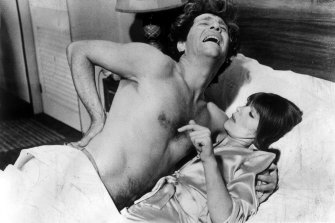
More recently, she was struck dumb again when Willem Dafoe knocked on her dressing-room door after a performance of Lear in New York. She tells me this story in response to me asking her if she is ever given to paying a compliment.
“Yes, but I think I do it rather gracelessly,” she says. Defoe is an actor she admires and when he walked through the door, “I went OOAHH [her mouth forming a big O and she roars] – I mean I was totally stupid and this poor guy with this mad woman going ‘Ahhaww” – so that’s me. I’m hopeless at it.”
I mean, what am I going to say to Samuel Beckett? Nothing absolutely nothing. I couldn’t think of a f–king word.
Glenda Jackson
So when you become speechless, we know that’s a compliment? “Absolutely.”
It is noticeable that, in the past, Jackson has been quite unspecific about her time as an MP and so I ask her to give me just one story about a constituent that stands out for her over the two decades.
She hardly hesitates before telling me about a 13-year-old boy whose parents were originally from Nigeria but had separated, the father returning to his home country, where he was a vocal opponent of the government. The son had gone to visit his dad when the house was attacked by the secret service; the father escaped but his boy was taken into custody.
Roll on 18 years and Jackson was canvassing in London’s West Kilburn “and this incredibly handsome, tall young man comes up to me and says, ‘Excuse me but you saved my life.’ I said, ‘I beg your pardon?’ He said, ‘I’m that boy.’
“And I’d never met him. Never expected to hear anything from him and he came up to me and said that. So there you go.”
I wonder whether, with all her toughness and grit, she allows herself to be touched by beauty. She says that she hopes that she responds to it and recognises it and then she tells me something which sums it up for her, which she has polished in her memory and held dear her whole life.
“I think my son was about four and I was bathing him and out of the blue he said, ‘You warm my heart’ – that’s probably the most beautiful thing I’ve ever heard.”
Sydney Morning Herald
If you would like to reprint this article, please click here