David Gilmour: ‘I’ve been bonded to Charlie since he was three. We were incensed by the injustice’
Charlie Gilmour went to prison for climbing the Cenotaph in 2011. Three years later, he returned to prison to hear a concert that changed his life – and his family’s
David Gilmour is the singer and guitarist in Pink Floyd, now a solo artist. He is married to the novelist Polly Samson and adopted her son, Charlie, by the poet and artist Heathcote Williams, who had walked out when their son was five months old, saying he couldn’t cope with having a baby. David has four children from his first marriage and three younger children, in addition to Charlie, with Polly.
Charlie, a journalist and campaigner for the Howard League for Penal Reform, was given a 16-month prison sentence in 2011 after swinging from a union flag at the Cenotaph, in London, while on a student demonstration, having admitted to violent disorder. Part of his defence was that he was off his head on drugs, dealing with being rejected by his biological father. At 21, and still at Cambridge University, he was one of the youngest inmates.
In 2014, Charlie returned to prison – this time as a member of the audience at Wandsworth for a concert by the charity I co-founded, Liberty Choir, whose members include serving prisoners. He was so moved that he persuaded his parents to come to the prison to experience the choir themselves.

In 2015, the Liberty Choir performed on the title single of David Gilmour’s No 1 solo album, Rattle That Lock. David Gilmour is now the patron of the Liberty Choir. Father and son describe this outcome as healing and transformative for the whole family – a way of walking out of the dark into the light.
I talked to David at the kitchen table at the house where he lives with Polly in Hove, overlooking the sea, where Charlie returned to live during his curfew months. A few weeks later, I visited Charlie at his new home in Camberwell, south London, which he shares with his fiancee, Janina Pedan (they are getting married later this month) and their rescued baby magpie, Benzene. The bird sits on their heads and happily lands lightly on visitors’ arms as I find, somewhat to my consternation, during our interview.
Both interviewees are gracious hosts: David making a perfect flat white and Charlie offering Turkish delight and tea, perhaps bearing out Charlie’s belief that nurture is stonger than nature.
Charlie Gilmour
As a small child, I had lots of dirty protests against David – shitting down the stairs and along the walls. When I got to the bottom of the stairs, I went into the bathroom with a pot of green paint and painted David’s face out of all of the photos. It was very bad of me – he had taken me into his home and nurtured me and then it turned out I was a cuckoo’s egg, cracked and broken, who threw all the other eggs out of the nest.
He was very calm about it all – I never remember seeing him get angry.
This phase went on for years and years and years. Up to the age of eight or nine, I refused to kiss him goodnight – I’d kiss my mother but not him – and he got very upset by that and would say, “Charlie, why don’t you kiss me Goodnight?” And I’d say, “I’m sorry, I’m just not gay.”
I had a lot of unresolved things with my biological father, and was confused, and it was hard to let David fill that space before I had dealt with the original person who was claiming that territory – although he [Heathcote] wasn’t claiming that territory.
My father was an unsolved mystery. I would periodically get, quite quietly, upset about it and then ask my mum to tell me about him and try to get to the bottom of why he had left. But she didn’t know either.
When I was 11, a mutual friend of my parents and Heathcote – a magician called Simon Drake – set up a meeting. He said to me, “Charlie, Do you want to get to know your biological father?” I immediately said yes.
I was very curious because all I had of him were these autographed books. The whale one, the car one, the elephant one… and, actually, I shouldn’t be mean about it because, even though it seems like a narcissistic thing to do, the only way he knows of emotionally connecting to people is through his poetry.
So we met, weirdly, in Yo! Sushi at Paddington station. He was wearing a jumper with holes in and an old tweed jacket and some cravaty thing – and I noticed we have the same eyes and chin. He’s a magician and did magic tricks, told me things about his life. I was quite charmed by him.
The role I had assigned to him was, he’s probably not going to take on the father role but he can be a sort of “interesting uncle” type figure in my life.
We then had another meeting, a few weeks later, at Simon Drake’s House of Magic, full of Victorian dioramas and sets, and he just wasn’t that interested. He was working on some campaign against GM crops and I was this 11-year-old playing on the floor with a noisy toy and it just felt like I was annoying him. I can still completely remember that feeling I had. I’ve sort of come to terms with it – but one thing that I did feel very strongly was the hypocrisy of someone wanting to save the otters but not really being able to care for his own child.
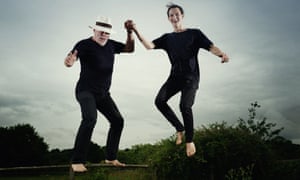
We had been exchanging emails … it was when the Harry Potter films were being made and I was quite into them. The second film had come out – because he was an actor I said that he would be excellent as the character Sirius Black (played in the films by Gary Oldman) – a man with wild black hair and wolfish. I wrote to him saying, “I think you should go for the role – you would be really good.”
And then, nothing, I was completely cut off. I think what had happened is that his mother had died.
I was fairly upset, I have to say. I had said in my head, “We’ll make this compromise. You don’t have to make up for all the years of not having been there but we can have this lovely, informal connection.”
And then he couldn’t even do that, which was… disappointing.
David, though, was and is, in many ways, the perfect father and we are now very, very close. He is a kind person, very generous with his time and his energy. We would climb trees together or make fires in the countryside. He had as much time as you want and was willing to put a lot of effort into going along with whatever projects interested me.
When I was 11, I wanted to build a little wooden chest. We worked on the plans together and after probably about half an hour, I slightly lost interest and came back eight hours later and, on his own, he had built this chest and sanded it and then I varnished it. It had a secret compartment, a false bottom – which was David’s design. I put little treasures – letters and stuff – in there. I still have it.
The most blissful family occasions for me now are when all the younger siblings are at the farm [the Gilmours’ family home in West Sussex] in the spring. We pick nettles and make a big nettle soup, sit by the fire and have a sing-song. The last time it happened, the Beyoncé album (Lemonade) had just come out and we made David cover the whole album from start to finish on the guitar. There was always so much music around in the house – it was a very nice thing to enjoy and discover and talk about – a Leonard Cohen record playing or something along those lines, and my dad was always strumming something.
At various times I’ve thought about being a father myself, or had to think about it, but as I’m only 26, I don’t feel I’m quite ready for a child, although I would like to in future. The question is whether I would be as hopeless as my own biological father – but as I believe in nurture over nature, I very much hope I would have my real father’s excellent parenting skills.
I felt very lucky to have the parents I have when I went to prison. [Charlie served four months, then four under house arrest (on tag when he moved back to his parents house in Hove), and then spent eight on probation.]
I felt very guilty that my parents were having to go through this. I was 21, so I was one of the youngest people in Wandsworth prison.
They didn’t know when I was safe or when I was in danger and my mum is quite morbid, so she was definitely imagining the worst. Before I went in I thought that [the possibility of being raped or worse] was going to be a real problem. When I went in, it wasn’t, which I am very happy about.
What I found very inspiring was the solidarity that exists between inmates generally. I am still friends with lots of the people I met in there. [He shows me a painting of him by an inmate.]
I was extremely lucky when I was in prison because I had this huge support network of family and friends and total strangers. That was one of the best things you can have in prison just to get you through. A lot of the other people I met didn’t. There was one cellmate who had been given four years. His mother had written to him once and that was to tell him not to write – he kept that letter under his bed and would occasionally just get it out and re-read it. I was getting 20 letters a day – my uncle sent a postcard every single day. It felt very unfair.
For me, prisons are more or less unremittingly depressing – people just being made worse. So when I came in and saw the Liberty Choir – something positive happening in prison – I was really shocked and quite inspired.
David and Polly have strong views about the prison system and they asked me if I thought it was worth supporting the choir. I said yes. And our involvement – me seeing some joy in prison, my parents knowing that such a programme exists in a prison – has been healing for all of us.
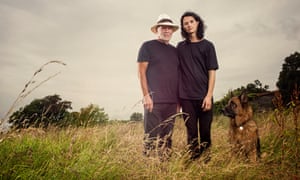
David Gilmour
I came on to the scene when Charlie was two. My ex-wife and I had been separated and on the road to divorce – I had been gone for four years. I was then 46 [he is now 70].
I loved Polly and I also loved her little boy. He was fantastic. He liked me at first, but when he realised that it was getting serious, he had a little change of heart. He was used to having just his mum – and me being there, well, he did a dirty protest once and said that I smelled, things like that.
It wasn’t bad at all. He was careful… he’s still very careful. He doesn’t give himself away to people, cheaply or lightly. He would always be very wary of people. But then Polly and I are like that, too. We’re not over-approachable and don’t leap into friendships with both feet. We’re wary and take our time.
Polly was quite ill at the beginning. She had glandular fever and was weak and was never that great at getting up in the mornings. I was an early bird – always happy to get up, always happy to make breakfast and nothing a kid could do could faze me. I’d already had four. He was Polly’s first but I was a skilled parent, you know. So I would be getting up, taking Charlie to school in Highgate – when he was two – before we even moved in together.
After Charlie was around, and before Polly and I had children, I did another Pink Floyd tour for six months or so in 1994. Then I made an album. Polly was home with Charlie but [my work commitment] wasn’t as ruthless – it was work in a studio in England, going home at six or seven at night, much more civilised. So the work is compatible with the family thing.
I love being a dad. It’s full of frustrations and annoyances and stuff, but the great moments are just so great. They are lovely. There are those moments, and have been with all of my children.
We thought I should adopt Charlie as soon as possible. I thought the chances were that Polly and I would have children together and that I should go on and adopt him to put him firmly in the whole thing.
There was some trouble with the older siblings and there was sometimes a little bit of ganging up on Charlie.
I have been asked whether they made an example of Charlie [going to prison] because he had a rock star father. The fact of the matter is that his first fame was a picture on the front page of a newspaper with the question, “Who is this girl?”
Because the picture of him swinging on the Cenotaph, with his long hair made them think he was a girl. So the first time it hit the newspapers, it wasn’t connected to me. But, of course, as soon as it became know that it wasn’t a girl and it was Charlie and he was my son and everything, you know…
I’ve been bonded to Charlie as his dad since he was three, so it was appalling and we were incensed with the injustice of it. We were very concerned about his welfare. Polly’s vivid imagination led her to being convinced that terrible things were bound to happen and my role was to convince her that they were not going to happen and that they were very, very unlikely to happen. So I had to dig into my compartmentalisation skills and insist to myself that there was no danger to him and that everything was fine, and to try to keep our family sanity together.
Actually, I wasn’t surprised when Charlie told me he was going back into Wandsworth prison to see the Liberty Choir. Nothing surprises me in that way about him because he’s a human being of extraordinary compassion. He’s a really good person. It is a very brave thing to do but then he’s a brave person.
Polly and I were both intrigued, when he told us about it afterwards, and we thought we’d go along to see what it was like – so we came to see the session with the big choir in the school and then into the prison choir, and found it amazing.
What is clear is that Charlie has tried to do something good with his experience.
The Guardian
David Gilmour is the new patron of the Liberty Choir, which was founded by MJ Paranzino and Ginny Dougary, and launched in Wandsworth Prison, south London, in 2014. If you are interested in donating, helping to reduce reoffending and offering prisoners a lifeline, find out more at libertychoir.org
If you would like to reprint this article, please click here